
In the GCC and wider Middle East, rehabilitation distribution is won by the companies that stay the longest, not the ones that arrive with the best product. Building a network here means accepting slow sales cycles, investing in regulatory registrations before the first order, and treating your distributor as a long-term partner rather than a sales channel.
This article sets out what that looks like in practice for manufacturers of rehabilitation, mobility, orthotic and prosthetic products. It draws on conversations with distributors in the region, including one who put it this way: you need to build a “Catholic marriage”, with protection.
Why are sales cycles so slow?
Sales cycles in regional rehabilitation are measured in years, not quarters, and a slow first year is normal rather than a warning sign. Most of the time goes on steps that happen before and around the sale: introductions, product evaluations, clinical champions, registration, tender cycles and budget approvals.
A purchase also rarely rests with one person. A clinician may like the product, a department head must back it, procurement must list it, and finance must fund it. Each step can restart when a role changes or a budget year closes.
The practical consequence for manufacturers is to set expectations internally before signing a distributor. If your board expects a return in twelve months, the network will be judged a failure before it has had time to work.
Why are cities the real markets, not countries?
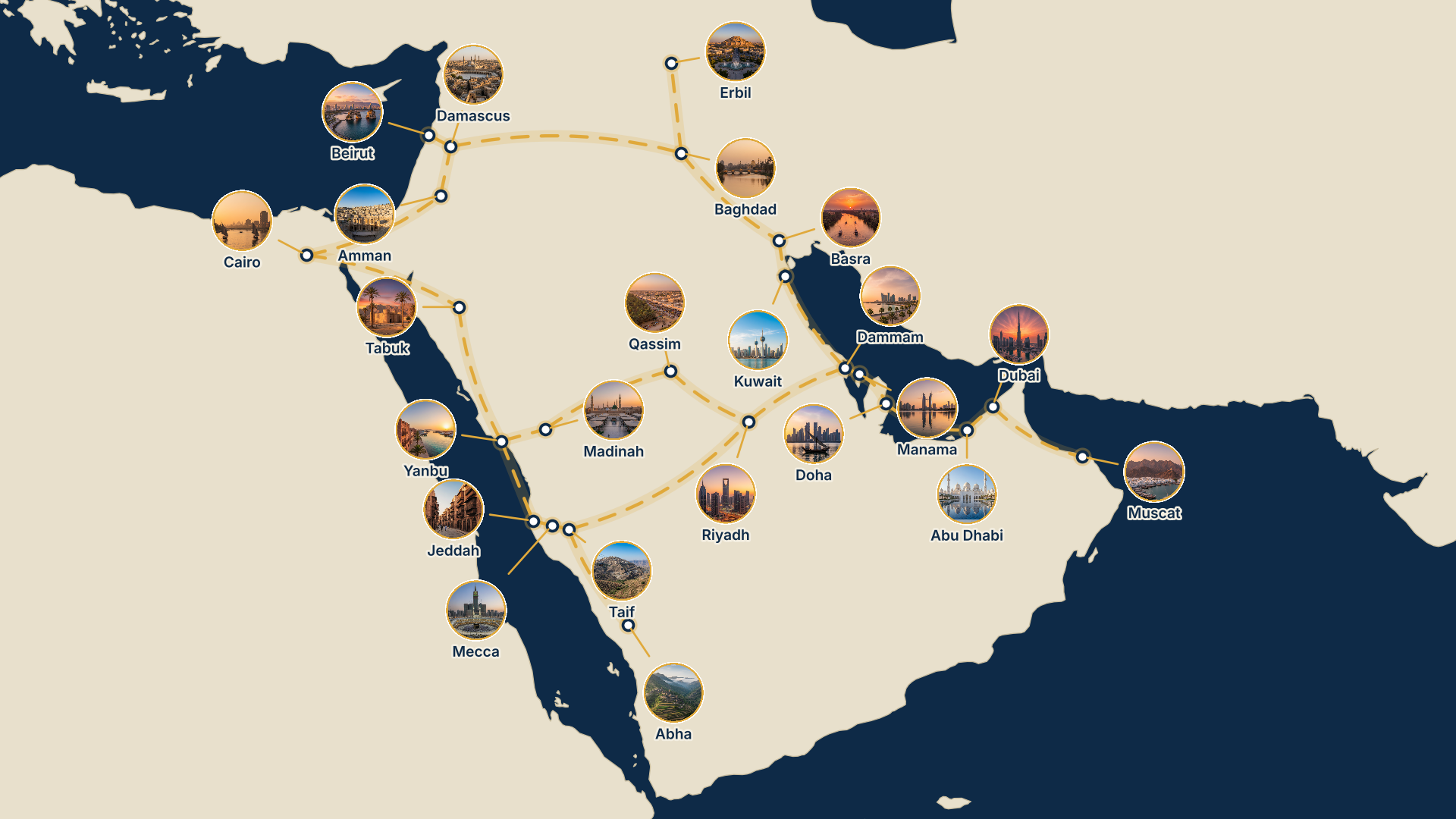
In this region the market is the city, not the country, so a plan built around “Saudi Arabia” or “the UAE” will miss how buying actually works. The pattern resembles the old desert trading posts: each hub has its own merchants, networks, customs and trusted names, and trade moves between them through people who know both ends.
The differences are practical, not just cultural:
- Saudi Arabia is several markets. The Eastern Province, Riyadh and Jeddah each have their own hospitals, clinicians, referral habits and business communities. Success in Riyadh does not carry over to Jeddah, and Jeddah does not carry over to the Eastern Province.
- The Gulf capitals and hubs differ from each other. Doha, Abu Dhabi and Dubai are distinct healthcare, clinician and patient markets, with different health authorities, funding and patient mixes.
- The wider region repeats the pattern. Kuwait, Muscat, Amman and Cairo each have their own healthcare systems, clinical cultures and patient populations.
For manufacturers this changes how a network is built. One distributor with a country-wide licence may be strong in one city and barely present in another. Treat each city as its own account plan, with its own relationships, clinical champions and timeline, and be ready to use different partners, or different teams within one partner, in different places.
This also reinforces the case for patience. Every new city restarts part of the relationship-building process, so the network grows one trading post at a time.
Why do relationships matter more than product?
In this market, buyers choose people they trust before they choose products they have compared. Clinicians and procurement teams want to know who will answer the phone when a device fails, who will train their staff, and who will still be there in five years.
That trust is built through repeated, visible commitment:
- Visits in person, often and over time, by both your distributor and your own senior staff.
- Local clinical training and after-sales support that works without escalation to head office.
- Honest answers about what a product can and cannot do.
- Continuity of contacts. Replacing a distributor’s key account manager, or your own regional lead, resets the relationship.
Product quality still matters, and a weak product will not survive. But a strong product with a distributor nobody trusts will lose to an adequate product with a partner everybody knows.
How should you approach government procurement?
Government and quasi-government buyers account for a large share of rehabilitation spending in the region, and they buy through formal, centralised systems. In Saudi Arabia, for example, public hospitals often purchase through central procurement bodies such as NUPCO, which affects approved suppliers, pricing and product availability.
These systems reward preparation and punish improvisation. Tenders have fixed documentation requirements, evaluation criteria and timelines, and a bid that misses a registration or a document is usually out, however good the product.
Three habits help:
- Get on approved supplier and product lists early, before a specific tender is announced.
- Build clinical demand at hospital level so that the product is requested by the people who write the specifications.
- Let your distributor lead. A local partner who knows the buyers, the paperwork and the calendar will usually outperform a manufacturer bidding from abroad.
Procurement rules differ by country and change over time, so confirm the current requirements with your distributor and the relevant authority before committing to a tender.
Why do registrations come before revenue?
Product registration is an up-front investment that pays back only after the registration is granted and the product is listed with buyers. Each market has its own regulator, such as the Saudi Food and Drug Authority or the UAE Ministry of Health and Prevention, and its own documentation, fees, labelling and language requirements.
Manufacturers should budget for registration as a core market-entry cost, covering:
- Regulatory staff time, document preparation and translation.
- Registration and renewal fees, and local authorised representative arrangements where required.
- Sample, testing and clinical-evidence requests that can arrive months into the process.
- Delays between submission and approval, which can run well beyond the original estimate.
A registration also ties you to a partner. In many markets the registration is held by, or closely linked to, a local entity, which is why the choice of distributor and the terms of the agreement matter so much. Check carefully who holds each registration and what happens to it if the relationship ends.
What is a “Catholic marriage, with protection”?
One regional distributor described the right relationship as a “Catholic marriage” with protection: a commitment meant to last, backed by clear terms in case it does not. The first half is about intent, the second about contracts, and a network needs both.
The commitment means each side invests as if the partnership is permanent. The manufacturer funds registrations, training and marketing support, and does not shop the territory to a second distributor at the first slow quarter. The distributor builds a team, holds stock and develops accounts around your brand rather than treating it as a side line.
The protection means an agreement that makes that investment safe for both parties. Points worth settling in writing, with local legal advice, include:
- Territory and exclusivity, and what performance justifies keeping them.
- Who owns and holds each product registration, and how it transfers on exit.
- Minimum commitments set at realistic levels for a slow-building market, with a ramp-up period.
- Termination terms, notice periods, stock buy-back and handover of customer and tender information.
- Governing law, dispute resolution and, where relevant, rules on commercial agency in the country concerned.
The protection is not a sign of distrust. It is what allows both sides to commit fully, because neither is exposed if circumstances change.
Why does long-term planning work?
Long-term planning works because every slow element of the market rewards the company that is already in place. A manufacturer that has registered its products, trained clinicians, earned a place on supplier lists and kept the same partner for years is hard to displace, while a newcomer must repeat the whole process.
A workable plan is built in stages rather than around a single launch date:
- Year one: foundations. Choose the market and partner carefully, agree the contract, start registrations and begin clinical education. Expect little revenue.
- Years two and three: access. Complete registrations, enter supplier lists and tenders, and convert early champions into repeat orders.
- Year three onward: scale. Extend to neighbouring markets, add products and deepen government and private accounts with the same partner.
Before committing, a manufacturer can test its readiness with a short checklist:
- Is leadership prepared to fund the market for several years before a return?
- Is a budget set aside for registrations, renewals and local training?
- Have we met the distributor’s team, visited their customers and checked references?
- Does the agreement settle registration ownership, exclusivity and exit terms?
- Do we have a named senior person who will visit the region regularly?
The Deliberate perspective
The companies that succeed in GCC and Middle East rehabilitation are deliberate about time: they plan for years, fund the groundwork, and choose partners they intend to keep. Speed is rarely rewarded here, but consistency almost always is.
If you are weighing entry into the region, or rebuilding a distributor network that has not delivered, get in touch with Deliberate to talk through the right partner structure, registration plan and timeline for your products.